- Your cart is empty
- Continue Shopping


692.50€
Steel: 3G
Hardness (HRC): 62
Wire: Convex
Spike: Full spike
Handle material: black Micarta
Sheath: Leather
Weight (g): 197
Blade length (mm): 101
Blade thickness (mm): 4.5
Total length (mm): 210
Finger guard: Nickel-plated silver
Availability: In stock
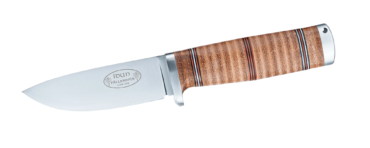
The special 2017 model year F1/3G with black Micarta is a very special edition indeed. Here, for the first time, is a distinctive and detailed laser engraving of the JAS 39 Griffin NG (Next Generation), with the traditional oval logo that has been Fällkniven ‘s trademark for over twenty years. The nickel-plated silver medallion on the handle is covered with a layer of 24-carat gold about 30 micrometres thick, normally only 2-3 micrometres are used. The guard, tubular rivet and handle rivets are made from nickel-plated silver on this exquisite full tang knife.
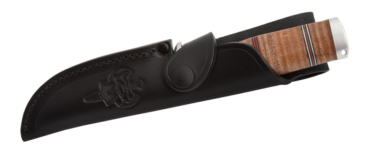
The knife comes with an all-black leather sheath in a neat gift box. It hasn’t yet been decided how many final editions there will be, but the first samples of just around a hundred pieces of each type will appear in spring/summer 2017. The reason the edition is so small, just one hundred pieces, is because the knife, in true Loveless design, is made entirely by hand. The blade is made from our best steel, a powdered steel we call 3G, a vanadium-molybdenum steel that holds its edge very well – of course, the blade has a convex edge, something we are the only ones in the world to offer. Although the knife is mainly sold as a collector’s item, the usual value is at least as high – all our knives are designed to be fully operational, and this really applies to the current F1/3Gmm and F1/3Gbm.
The first outlines of our best-selling F1 saw the light in 1987, 30 years ago. Our company was given the task by FMV/Aerospace to develop a new survival knife for Swedish military pilots, a truly exciting project. We started by buying numerous knives in a certain size range, one premise being that the knife would fit in the leg pocket of the pilots’ clothing. It should be sturdy, stay sharp, have an ergonomic and comfortable shape, and be usable with wet and frozen hands. You should also be able to split wood, use it for field wound surgery and work in battle, to name but a few properties.
An impossible task?
We started with field tests of a large number of knives, both sheath knives and folding knives, the vast majority from well-known and reputable manufacturers in the USA, Europe and Japan. Curiously, none of them were up to it! The bottleneck was the Swedish winter, which defined the limits of what was possible. When it came to the folding knives, we found that they were too weak and not reliable enough, especially when it came to snow, ice or dirt in the locking mechanism. The sheath knives seemed to have coolant metal details on the handle or caused blisters, or were designed in such a way that they didn’t provide a secure enough grip.
In that situation, I sat down and began to define the parameters of what a survival knife for pilots should look like, and that was a real challenge. The reason the knife had to be light was because, if it was too heavy, it would tear the fabric of the leg pocket to shreds if the pilot was forced to eject from a crashing plane, all down to large G-forces. At the same time, it still had to be strong and stay sharp well.
It’s become a hunting knife!
As a hunter, he knew how the knife should be held in his hands, even if they were bloody, sweaty or his fingers were cold or wet. I solved the edge retention by using a special corrosion-resistant high-alloy steel from Hitachi Metal Corp. in Japan, a steel that the Boeing factory used for the rotor blades on its huge aircraft engines. As usual, such ideas came from knife makers in the USA, where especially the now deceased Robert W. Loveless, the best knife maker of all time, was the one who pushed for the development of thinner steel knives. I had the pleasure of talking to him in 1997 and he could, among other things, tell me that he had seen an F1 knife and liked what he saw, as he put it. I asked him where he got his inspiration when designing his knives and, to my surprise, he told me it came from Scandinavia! The answer surprised me, but he said that he had always liked the simple, clean lines of Scandinavian knives and that this had been the guiding star of his production. Bob Loveless died in September 2010 at the age of 81, but his design will live on for a long time – he is considered responsible for introducing the drop-point design to knives, a design that hunters appreciate very much.
In August 1995, Fällkniven AB was able to deliver several thousand knives to the Swedish Air Force. The following year, the knife was introduced to the civilian market, and this led to viral success. As a result, we stopped selling other brands and concentrated on designing, developing, manufacturing and selling only our own products. The F1 Pilot’s Survival Knife was the first production sheath knife in the world equipped with blades made of special steel and that seemed very attractive twenty years ago. The F1 blade has been updated over the years in terms of technical content, but the original design still remains.